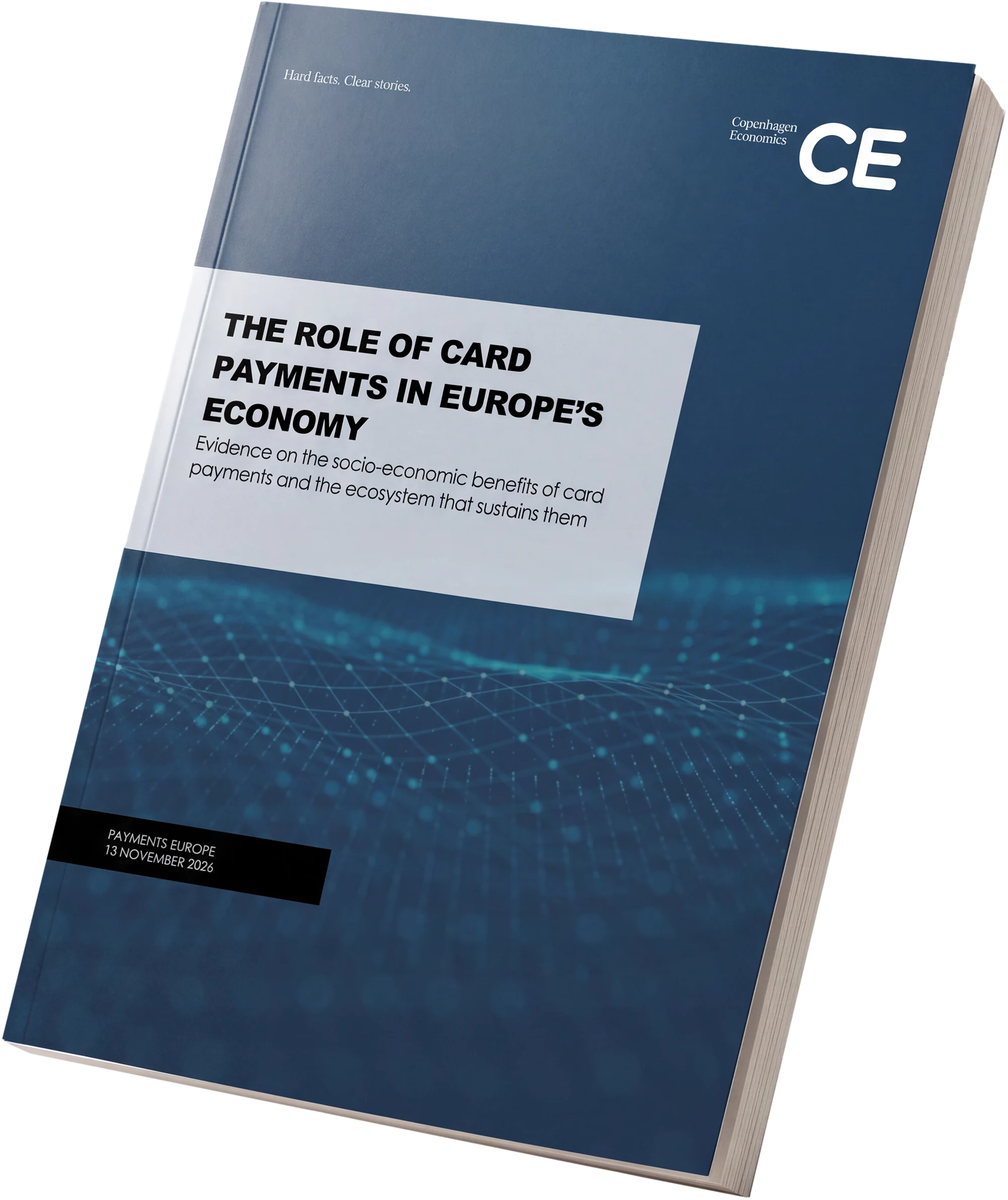
New independent research from Copenhagen Economics
The role of card payments in Europe’s economy
Card payments play a central role in Europe’s economy, supporting everyday transactions, enabling commerce and helping consumers and businesses participate in an increasingly digital society.
This new independent study by Copenhagen Economics, commissioned by Payments Europe, assesses the socio-economic value generated by card payments across the European Union. It examines the benefits delivered today, the potential gains associated with continued voluntary adoption and the wider ecosystem that supports secure and reliable card-based transactions.
New independent research from Copenhagen Economics
The role of card payments in Europe’s economy
Card payments play a central role in Europe’s economy, supporting everyday transactions, enabling commerce and helping consumers and businesses participate in an increasingly digital society.
This new independent study by Copenhagen Economics, commissioned by Payments Europe, assesses the socio-economic value generated by card payments across the European Union. It examines the benefits delivered today, the potential gains associated with continued voluntary adoption and the wider ecosystem that supports secure and reliable card-based transactions.
Key findings
The study provides new evidence on the economic value generated by card payments today and the opportunities associated with continued adoption across Europe.
€19.8 billion
Annual economic benefits across consumers and merchants in the EU in 2024.
€33 billion
Annual economic benefits across consumers and merchants could reach approximately €33 billion by 2035 if recent adoption trends continue.
€21.6 billion
Additional annual VAT revenue associated with increased card usage since 2014.
48%
Of EU point-of-sale transactions were made by card in 2024, up from 27% in 2016.
Delivering measurable benefits today
The study estimates that card payments generated approximately €19.8 billion in annual economic benefits across consumers and merchants in the EU in 2024. The estimate takes a societal perspective and captures resource savings and wider consumer welfare gains rather than fees transferred between consumers, merchants and payment providers.

Consumers
Approximately
€11 billion
in annual benefits in 2024, including:
- Faster and more convenient payments
- Fewer cash withdrawals
- Greater security and fraud protection
- Chargeback protection and improved payment confidence

Merchants
Approximately
€8.8 billion
in annual resource savings from lower payment-handling costs in 2024, including efficiencies from:
- Faster transactions
- Reduced cash counting and reconciliation
- Lower cash storage, transport and banking requirements
- The ability to spread fixed acceptance costs across more transactions
Untapped economic potential
Significant investment has already been made in card acceptance, technology and security across Europe. Around 92 to 93 per cent of consumers in the euro area hold a payment card and 88 per cent of merchants with physical points of sale accept card payments. Yet cards still account for less than half of EU point-of-sale transactions.
This creates scope for additional transactions to move to cards without requiring an equivalent expansion of the underlying acceptance infrastructure. If recent adoption trends continue, annual economic benefits across consumers and merchants could rise from €19.8 billion in 2024 to approximately €33 billion by 2035.


Supporting public finances
Higher card usage is associated with stronger VAT compliance through greater transaction traceability. The study estimates that increased card usage since 2014 was associated with approximately €21.6 billion in additional annual VAT revenue by 2024, all else equal.
This estimate is indicative and should not be interpreted as a causal decomposition of the EU VAT Gap, which is influenced by several factors, including enforcement, fiscal administration, digitalisation and economic conditions.
The benefits go beyond what can be quantified
The quantified estimates capture only part of the value created by card payments. The study also explores wider benefits that cannot be measured consistently across the EU but remain important to Europe’s economy and society.
- Secure digital commerce
- Cross-border trade and market access
- Innovation and digital wallets
- Fraud prevention and consumer protection
- Operational resilience
- Consumer choice and convenience
Together, these benefits help support a modern, competitive and innovative European economy. They depend on continued investment across the card payment ecosystem in fraud prevention, cyber security, monitoring, redundancy, business continuity and recovery capabilities.

A diverse and resilient payments ecosystem
The Copenhagen Economics study shows that card payments support consumers, merchants and governments through greater efficiency, convenience, security and trust. Continued voluntary adoption and innovation can further strengthen these benefits in the years ahead.
The study also highlights the importance of diversity and competition across Europe’s payments ecosystem. Domestic and international card schemes, account-to-account and mobile solutions, cash and emerging pan-European initiatives give consumers and merchants choice, support payment continuity and create incentives for continued investment in service quality, security and innovation.
Methodology, sources and resources
About the study
The Role of Card Payments in Europe’s Economy was developed by Copenhagen Economics and assesses the socio-economic value generated by card payments across the European Union. The analysis examines benefits for consumers, merchants and governments, as well as the wider payments ecosystem that supports secure and reliable card-based transactions.
The study combines desk research, stakeholder interviews, publicly available statistics, industry data and economic modelling. It adopts a societal perspective and quantifies benefits that can be measured consistently across the EU, including resource efficiencies, consumer welfare benefits and VAT revenue effects. Wider benefits relating to market access, digital commerce, payment innovation, acceptance and payment continuity are also assessed qualitatively.
The report draws on data and evidence from, among others, the European Central Bank, European Banking Authority, Eurostat, national central banks and peer-reviewed academic research.
Methodology qualification
The €19.8 billion estimate represents selected quantifiable socio-economic benefits and should not be interpreted as a complete valuation of card payments. It includes direct resource-efficiency gains and wider consumer-welfare effects, but does not capture the full value of card-enabled innovation, market access, digital integration, payment continuity or established trust and protection frameworks.
The €33 billion figure is a scenario-based estimate, rather than a forecast. It illustrates how annual economic benefits across consumers and merchants could develop if recent card-adoption trends continue. The €21.6 billion VAT estimate is indicative and represents an association with increased use of traceable card payments, holding other factors constant; it is not a causal decomposition of the EU VAT Gap.
Downloads and resources
- Full report: The Role of Card Payments in Europe’s Economy
- Infographic: The Value of Card Payments in Europe’s Economy
- Press release: New Copenhagen Economics Study Finds Card Payments Generate Close to €20 Billion in Annual Economic Benefits Across Europe
- Media enquiries: For further information or interview requests, please contact secretariat@paymentseurope.eu
Source citation
The Role of Card Payments in Europe’s Economy, Copenhagen Economics, commissioned by Payments Europe (2026).
About Copenhagen Economics
Copenhagen Economics is an expert-driven consulting company built on a deep knowledge of applied economics, and one of the leading economics firms in Europe. Copenhagen Economics believes sound economic analysis can equip decision-makers with the hard facts and clear stories to make better choices for the benefit of society.
About Payments Europe
Payments Europe is the voice of the card-based payments industry in Europe. Its mission is to promote a better understanding of the complexity of card-based payments and the inherent value they bring to society. Payments Europe supports a vibrant, innovative and competitive European payments market based on a balanced regulatory framework that puts consumers and consumer protection at the heart of everything. Payments Europe’s members are card issuers, card acquirers, card schemes and other businesses that offer card-based payment solutions in Europe.